Labels

Monday, May 1, 2023

CULTURE WAR: CHRISTINITY VS WOKENESS


Since its beginnings in the first century, the church has faced varied resistance from the surrounding culture and challenges to the gospel. Recently, a new challenge has emerged: "wokeness," or the state of being "woke." Merriam-Webster identifies "woke" as a slang term meaning being "aware of and actively attentive to important facts and issues (especially issues of racial and social justice)." On the surface, wokeness might sound like seeking justice and showing concern for the weak and oppressed--things the Bible urges us to do (Isa. 1:17, Micah 6:8). However, wokeness often embraces theories and ideologies inconsistent with or even hostile to the Bible. Many well-intentioned Christians--out of a desire to be compassionate, accepting, and loving--are succumbing to cultural pressure to conform to woke ideology, likely unaware of its unbiblical tendencies.

To help Christians think biblically about wokeness, Owen Strachan, FRC's Senior Fellow for Biblical Worldview, has written a new book, Christianity and Wokeness: How the Social Justice Movement is Hijacking the Gospel. In the book, Strachan walks through the history of woke ideology and examines its consequences in American culture and the church. He also consults Scripture to give Christians advice for responding to the woke movement.

Wokeness in the Culture and the Church

The first two chapters of Christianity and Wokeness examine how woke ideology is entering the culture and, more consequentially, the church. According to Strachan, "wokeness" means to be "awake" and in tune with the prevailing zeitgeist. Critical Race Theory (CRT), which sees society as an intentional system of power structures meant to oppress others based on their skin color, is currently the most well-known example of woke ideology. CRT purports that "White Privilege" is at the root of social justice issues and must be eradicated.

The 21st century American church has been both passively and actively incorporating woke ideology into their institutions and practices. Strachan observes that some Christians have started apologizing for and repenting of their "whiteness." Often these actions are prefaced with the proposal that we should change the gospel to fit with woke ideology so that brothers and sisters of color will be more comfortable in the church. While true racial reconciliation is an important outworking of the gospel (Eph. 2), wokeness changes the gospel by teaching that white people are never able to fully repent for their actions because they are inherently racist by nature of being white. But the gospel says all have sinned, and everyone can be fully redeemed through the work of Christ. With its different view of sin and redemption, wokeness undermines the gospel. This is why Strachan argues, "[W]okeness is not a prism by which we discover truths we couldn't see in a Christian worldview. Wokeness is a different system entirely than Christianity. It is, in fact, 'a different gospel.' But it is not just that. In the final evaluation, wokeness is not just not the Gospel. Wokeness is anti-Gospel."

Why is Wokeness an Ungodly System?

In chapters three and four, Strachan outlines his concern with the theological and cultural implications of CRT and woke ideology. First, he encourages believers to guard their hearts and minds, noting the apostle Paul's admonition not to be taken captive by false philosophies (Col. 2:8). Strachan argues that wokeness represents a man-centered gospel that takes others captive through legalism rather than setting them free in the grace of Christ. In other words, wokeness says that only your works can save you--but you can never actually accumulate enough works to satisfy its requirements. Ultimately, this philosophy promises so much, only to abandon its followers in the end.

Furthermore, Strachan provides guidance for responding to unbiblical ideologies. According to Strachan, wokeness calls into question the sovereignty of God and contradicts Scripture by saying that the root of all evil is "whiteness." But, as Strachan explains, "[in] biblical terms, 'white' skin is not our biggest problem. Sin is." He goes on to say, "If you have been convicted and demeaned for your skin color or heritage (whatever each may be), you have been wronged." Woke ideology turns humans against one another, and results in individuals being judged by the color of their skin and status in society rather than the content of their character or their status in the eyes of God.

The Bible and Ethnicity

Because questions of race and ethnicity are so closely tied to woke ideology and CRT, chapter five and six provide an in-depth study of what the Old and New Testament have to say about our identity as human beings. Strachan explains how Genesis teaches that all humans are equally part of one human race. Although we may have different skin tones, languages, or ethnicities that distinguish us, we are all human beings who are made in the image of God (Gen. 1:26-27).

Further, the doctrine of the fall--not CRT--explains the fractured relationships present in humanity. It is not the differences between our skin colors that make us misunderstand, betray, and abuse one another but the sin that infects us all. One tragic consequence of the fall is the sin of racism, which is one way that humans wrongly show partiality. God is not elitist and shows no partiality to anyone, as the apostle Paul frequently discusses in his letters (Rom. 2:11, 10:12; Gal. 2:6, Eph. 6:9). The New Testament also demonstrates how everyone can be united and reconciled in Christ through the gospel message (Eph. 2:14-18, 2 Cor. 5:16-21). God desires that, ultimately, every tribe, tongue, and language be untied in Christ to form the household of God (Eph. 2:19; Rev. 5:9-10, 7:9, 21:3). As Strachan explains, "Distinctiveness is no bad thing and is, in truth, a gift and blessing of God--but unity will be our song in all the ages to come."

The Response to Wokeness

The final chapter of Strachan's book considers the reality of American history, specifically slavery and the civil rights movement. He concludes with recommendations for how Christians can respond to woke ideology in a biblical way, reminding his readers: "We cannot fall silent. We cannot stand by as people around us are taken captive by wokeness or any ungodly ideology."

Although Christians ought to recognize racism's sinfulness and the necessity of repentance for racist thoughts, actions, and attitudes, they should also recognize that certain groups of people are not inherently racist simply because of the color of their skin. Strachan concludes, "Wokeness is advancing far too quickly to treat this matter lightly, or to assume that these issues will simply 'go away.'" He reminds his readers, "No--they will not go away. As we have argued throughout the book, strongholds and false ideologies must be destroyed, not ignored or treated with a softshoe approach."

May we all heed this timely warning and put on the full armor of God (Eph. 6:10-17) to stand firm against all unbiblical ideologies in our day and proclaim the gospel of truth.

Owen Strachan's recent interview about his new book on Washington Watch with Tony Perkinscan be viewed here.


Thursday, April 27, 2023

The Abuse of Men By Women | Abuse Doesn't Care About Gender


Partner Abuse books by Ann Silvers
 
"Abuse isn't always just one direction with a man being mean and a woman being victimized." Counselor, coach, and author, Ann  Silvers, joins us to shine some light on the rarely discussed relationships which involve women abusing men. Domestic violence and emotional abuse don't care about gender. Episode 226, February 16, 2021 See the book Abuse Of Men By Women → https://amzn.to/3qqbcqO  
 

Men can be on the receiving end of an abusive relationship! It could be from an emotionally abusive girlfriend, a physically abusive wife, or a female partner who is demanding, controlling, manipulative or bullying using any of the 7 forms of partner or spousal abuse.

This ground breaking book shatters the silence surrounding partner abuse where the target of the abuse is a man and the source of the abuse is a woman. It challenges the common perception that domestic violence and other types of partner abuse only happen to women.

Counselor and relationship coach, Ann Silvers, M.A., questions the cultural trend to ignore, condone, laugh at, or even applaud women treating men in ways that would be rightfully condemned if the genders were reversed.

Her unique perspective as a woman who herself was the target of partner abuse by a man, and who also recognizes that there are abusive women and abused men, has resulted in a book that is a cultural game changer.

This book stands alone with its gripping personal stories and detailed yet concise descriptions of emotionally abused men as well as every other form of partner abuse of men by their female partners: verbal, psychological/emotional, financial, spiritual, legal, physical, and sexual abuse.

"It Happens, It Hurts" describes what abuse OF men BY women looks like, why women do it, how we are supporting and encouraging women to abuse men, how men get pulled into these dysfunctional relationships, why they stay, the impact abusive or manipulative women have on men, and what can be done about it.

This book arms men with the information they need to avoid getting hooked into relationships with abusive or manipulative women.

It provides refreshing recognition, understanding, and direction for abused men who are struggling to deal with, or recover from, difficult relationships with an abusive wife or girlfriend.

And it helps women examine how they treat their husbands and boyfriends.

"It Happens, It Hurts" is a road map for men and women looking to help their brothers, fathers, sons, and friends who are being abused by women or teach them how to avoid getting pulled in by them.It is a call to action for helping professionals (teachers, counselors, ministers, police officers . . .) and all people who are willing to see what is really going on.


Tuesday, April 25, 2023

THE CONSEQUENCES OF HAVING AN ABORTION. WHAT THEY DON'T WANT YOU TO KNOW!


The Risks of Abortion

The pro-abortion movement has gone to great lengths to downplay the risks of abortion to the mother, but these risks are very real. This article will examine some of the common consequences of abortion. As we shall see, aside from always resulting in a dead baby, abortions are also dangerous to the mother.

Injuries to Women

We have all heard abortion stories—like Abby Johnson’s—of women given little-to-no aid after their abortions. In his book Abortion Practices, prolific late-term abortionist Dr. Warren Hern once admitted: “In medical practice, there are few surgical procedures given so little attention and so underrated in its potential hazards as abortion. It is a commonly held view that complications are inevitable.”1

depression: one of the risks of abortion for women

Not much has changed since his admission. Women are often injured, as Operation Rescue repeatedly documents. And women still suffer both short-term and long-term effects. In a 2019 amicus curiae brief, former abortion providers Dr. Kathi Aultman, Carol Everett, Dr. Anthony Levatino, and Dr. Beverly McMillan testified in Louisiana to the need for abortion doctors to have hospital admitting privileges. They testified because they understand the frequent dangers to the mothers—dangers that are exacerbated when the abortionist cannot or will not send mothers to the hospital after something has gone wrong.

According to the brief:

Reliable scientific and medical studies confirm the physical and psychological risks of abortion. In the largest government study, the Report of the South Dakota Task Force reviewed the scientific studies and heard testimony from medical experts and post-abortive women. The Task Force concluded that there are serious physical and psychological consequences of abortion and women should be protected.

The brief goes on to cite the evidence from the task force:

In creating the Task Force, the Legislature recognized that “there exists a need for special protection of the rights of such pregnant women, and that the State of South Dakota has a compelling interest in providing such protection.” After hearing evidence from medical experts and post-abortive women, the Task Force stated:

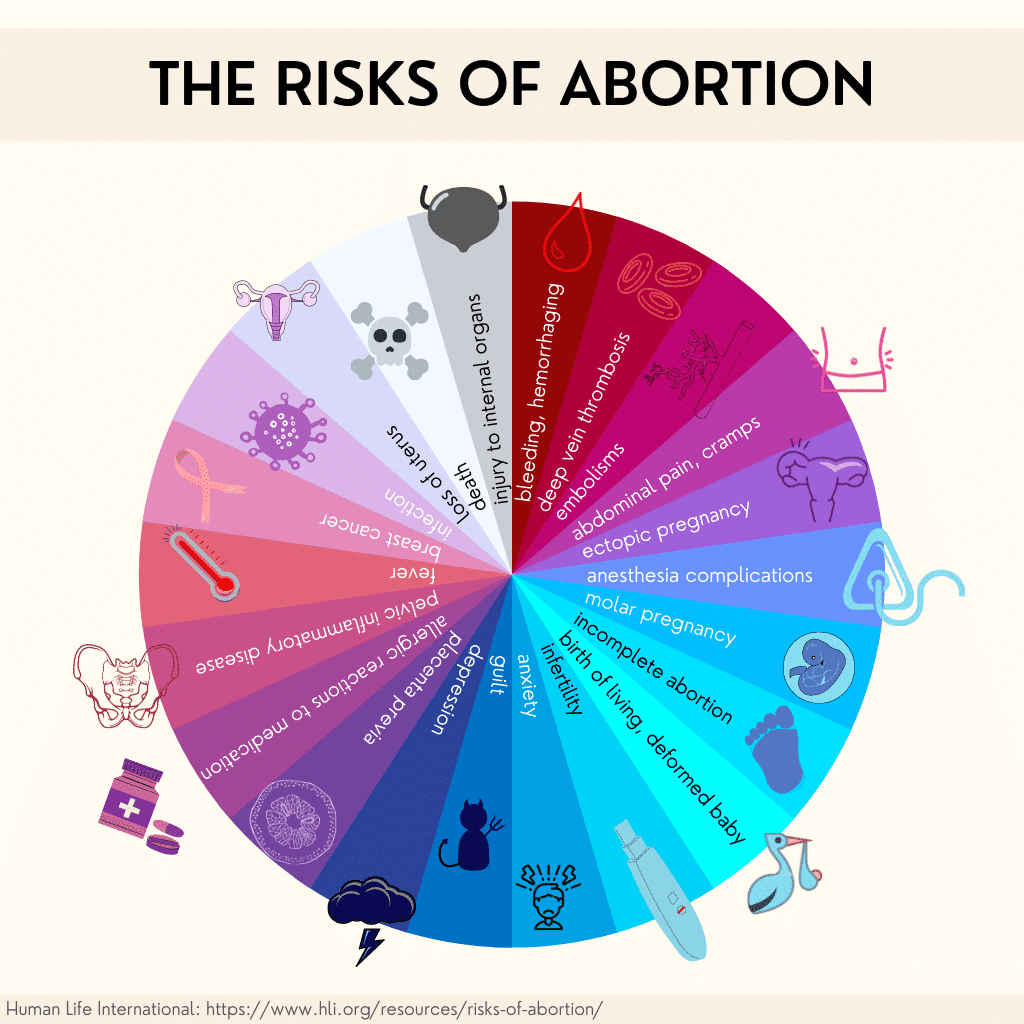
The record reflects that abortion places women at increased risk of physical injury including the risk of: infection, fever, abdominal pain and cramping, bleeding, hemorrhage, blood transfusion with its subsequent risks, deep vein thrombosis, pulmonary or amniotic fluid embolism, injury to the cervix, vagina, uterus, Fallopian tubes and ovaries, bowel, bladder, and other internal organs, anesthesia complications (which are higher with general anesthesia), failure to remove all the contents of the uterus (leaving behind parts of the fetus/baby or placenta), need to repeat the surgery, possible hospitalization, risk of more surgery such as laparoscopy or exploratory laparotomy, possible hysterectomy (loss of the uterus and subsequent infertility), allergic reactions to medicines, mis-diagnosis of an intrauterine pregnancy with a tubal or abdominal pregnancy being present (which necessitates different treatment with medicines or more extensive surgery), possible molar pregnancy with the need for further treatment, emotional reactions (including but not limited to depression, guilt, relief, anxiety, 5 Id. at 5. 6 etc.) death of the woman, and risk of a living, injured baby.

In addition, the Task Force heard evidence that there are long-term consequences of abortion including that abortion places women at increased risk of other long-term physical injury including placenta previa which necessitates a c-section and has higher rates of complications and pre-term birth in subsequent pregnancies.

In addition to the risks to the health of the mother, there is also the risk of death. According to Raymond Adamek, who has researched and written about this subject:

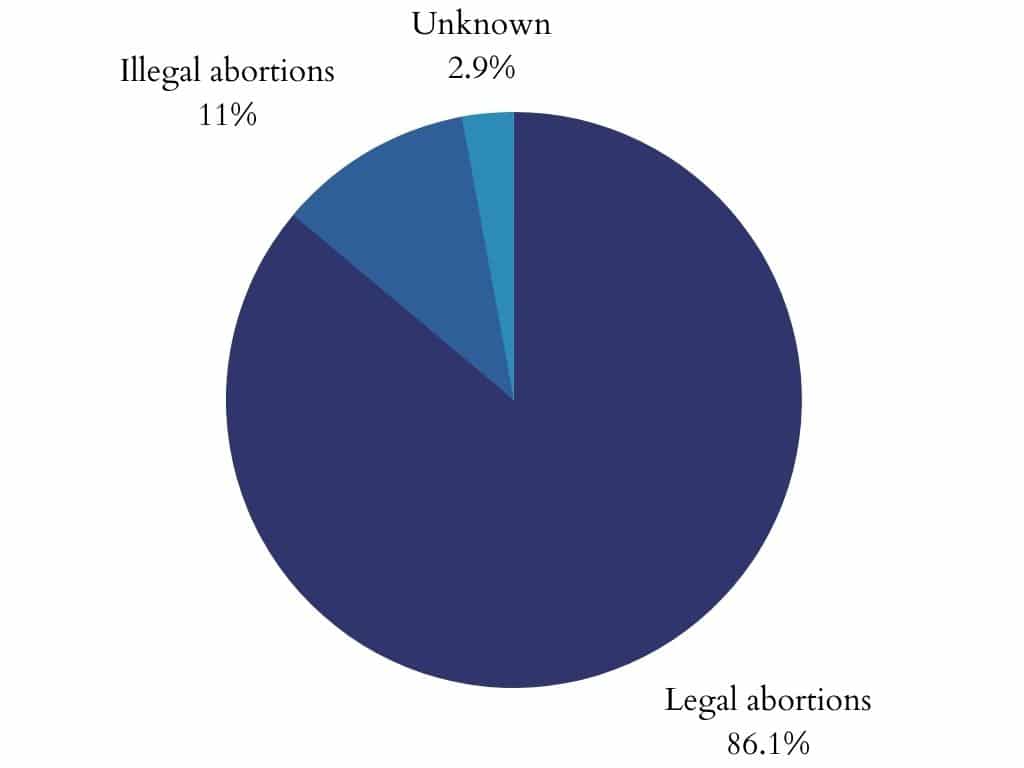
The most recent (November 27, 2020) Abortion Surveillance report by the CDC, covering 45 years from 1973 through 2018, indicates that, out of 519 maternal deaths, 86.1% resulted from legal abortion, 11% from illegal abortion, and 2.9% from abortions whose legal status was unknown.


Maternal Deaths from Abortion, 1973 – 2017


Hence, on average, legal abortion accounted for almost 10 maternal deaths per year, which might suggest that legal abortion is quite “safe,” given the number of annual abortions performed. However, we should note that not all states give information about abortions to the CDC. A 10-year review (2007 through 2016) of CDC reports indicates that California, Maryland, and New Hampshire did not report. The current CDC report says that, according to the Guttmacher Institute, in 2017, these three states saw 19% of the nation’s abortions. Furthermore, the CDC has noted that its annual reports only include 68-71% of the abortions reported by Guttmacher’s survey of clinics.

Aside from these flaws in recording, we also see other factors that come into play regarding why we have difficulty getting accurate statistics about abortion-related injuries.

For instance, abortion clinics give women the option of seeing their primary doctor for the follow-up visit. Whether this is for the comfort of the women or for the convenience of the abortion industry is open to interpretation, but the result is that many injuries are unreported or are reported as something else. Further, women who suffer complications rarely return to the abortion clinic but go to the emergency room. This is especially common when a woman has taken an abortion pill. In this case, she may present herself as suffering from a miscarriage. In addition, when women do suffer complications from botched abortions—or die—their injuries or deaths are often attributed to other causes, especially since many women want to keep their abortions secret.

Related: What Percentage of Abortions Are Medically Necessary?

What Are the Risks of Abortion?

The risks of abortion are many. Besides the women who die each year from legal abortions, many women suffer other injuries—both physical and psychological. And though the reported number of women who die may be “small,” even one death is too many. So let’s examine the risks:

The risks of abortion - infographic

Pelvic Inflammatory Disease

PID is life-threatening and can lead to subsequent infertility and an increased risk of ectopic pregnancy. The long-term effects of PID can be devastating for the woman. Further, PID can permanently damage and scar the fallopian tubes, or even cause blockage of the tubes. If a woman has an STD at the time of her abortion, her risks for PID are even greater. According to a 2020 Pregnancy Care Clinic article, “If you have untreated chlamydia or gonorrhea, you’re up to 23% more likely to develop PID after an abortion. The reason this happens is that bacteria from outside your body can be transmitted into your reproductive tract.”

Placenta Previa

Placenta previa happens when the placenta becomes superimposed on the cervix and causes severe hemorrhage during labor. A 2017 article examining this condition has found a “significant association” between induced abortions and placenta previa. In 2006, the Catholic News Agency solicited two obstetricians and a family practice doctor to prepare a list of complications following abortion. According to this report: “Several studies analyzed in a landmark 2003 article in the Obstetrical and Gynecological Survey show that induced abortion also increases the risk of placenta previa by 50%.” The CNA further reports: “Placenta previa occurs 6 to 15 times more often after a woman has had an abortion.”

Ectopic Pregnancies

Abortion is also related to an increase in ectopic pregnancies in future pregnancies, which can seriously threaten the mother’s future fertility and even her life. The Catholic News Agency report referenced above states that “statistics show a 30% increased risk of ectopic pregnancy after one abortion and a 160% increased risk of ectopic pregnancy after two or more abortions.”

Cervical Lacerations

Cervical lacerations, or tears in the cervix, are said to occur in three percent of second-trimester abortions. Less severe undiagnosed cervical damage may result in subsequent cervical incompetence, premature delivery, and labor complications. Cervical damage and scarring of the endometrium from abortion may also increase the risk of abnormal development of the placenta in subsequent pregnancies, thus increasing the risk of birth defects.

Uterine Perforation

Between 0.1 and 3.0 per 1,000 of aborting women suffer perforations of the uterus during a vacuum aspiration abortion. Sadly, most of the perforations caused during first trimester abortions go undiagnosed. These injuries could lead to future problems that may require a hysterectomy or other major corrective surgery. Perforations occurring during late-term abortions are more frequent and always serious in nature.

Breast Cancer

The risk of breast cancer after abortion has been hotly debated for many years. Some studies claim there is no risk, while others have found a correlation. As the American Cancer Society explains, the different results come from the different ways the studies were conducted.

According to AbortionBreastCancer.com, research has shown “a statistically significant 40% risk increase [of breast cancer] for women who have had abortions.” CompassCare is a nonprofit healthcare center in New York. In an effort to be forthright regarding the risks of abortion, its site lists several short-term and long-term side effects. One such note addresses the breast cancer link and says: “Studies show that abortion increases a woman’s risk of breast cancer. A 2013 analysis revealed a 44% increased risk of breast cancer among females who had at least one induced abortion. The relative risk increased to 76% and 89% for those who had at least two or three abortions, respectively.”

Infertility and Future Childbearing

Having an abortion puts the mother at risk in subsequent pregnancies or may even leave her infertile. According to CompassCare:

First-trimester surgical abortion by dilation and curettage (D&C) “can result in uterine synechiae (or Asherman’s Syndrome), which increase the risk of subsequent midtrimester spontaneous abortions and low birthweight deliveries.” Incompetent cervix is also a preterm birth risk associated with surgical abortion. “Symptoms related to cervical incompetence were found among 75% of women who undergo forced dilation for abortion.”

The site goes on to say that the woman most at-risk for these complications include women who smoke heavily; have an IUD; have uncontrolled high blood pressure; have heart, liver, or kidney diseases; or who take certain steroids or blood thinners.

Psychological Risks

In addition to these physical risks, abortion also entails great psychological risks to women. Many women suffer from Post-Abortion Syndrome, which according to a Pregnancy Care Center article, is a type of PTSD. The center has found that women who have had abortions feel guilt and anxiety, have suicidal thoughts, feel numb, develop eating disorders, abuse alcohol and drugs, resort to sexual promiscuity, and find themselves unable to bond with future children.

These findings are consistent with what the staff at the Living Well Medical Clinic have found, though they refer to it as Post-Abortion Stress Syndrome. The Living Well Medical Clinic is a national helpline for abortion recovery, and according to its site, its staff members have seen “thousands of women who are traumatized from their abortion experience.”

Whether called Post-Abortion Syndrome or Post-Abortion Stress Syndrome, this serious and heartbreaking condition is real. Yet it has been strongly denied by the pro-abortion movement for years. In the 1980s, NARAL Pro-Choice America claimed that no evidence was found for this syndrome by Surgeon General C. Everett Koop when he was assigned by President Reagan to study it in 1987. And despite all the evidence to the contrary, these pro-aborts still make this claim today.

However, even then, Koop was enraged at this twisting of his words, telling an interviewer:

Instead of saying “the Surgeon General could not find sufficient evidence to issue a scientifically statistically accurate report that could not be assailed,” the Associated Press said, “He could find no evidence.” I know there are detrimental effects [from abortion]. I have counseled women with this problem over the last fifteen years. There is no doubt about it.2

According to Rachel’s Vineyard, Koop went on to say that the studies were flawed because they didn’t examine the respondents long enough. He recommended that more money be spent on longitudinal studies to obtain accurate results.

Indeed, we know that regret often takes years to surface. According to a recent HLI article:

Despite a new study that claims that women feel relief five years after having an abortion, this is not what pro-lifers working in the field see. They see an increase in the number of church groups and other post-abortive ministries. They see an increase in the number of people seeking counseling after an abortion. And they see women seeking counseling 10 or even 20 years after an abortion. Regret can happen any time, and women need help healing.

Again, we see that, in order to find truly accurate results, studies must follow post-abortive women for a longer period of time. Five years is not long enough to study women’s behaviors and emotions to determine how they will feel, especially as many are still young and have not yet realized or understood the gravity of their actions.

Healing and Forgiveness

But, when women (or men) do want help, healing is possible. Many organizations exist that can help post-abortive men and women heal. One such organization is Rachel’s Vineyard. Its staff understand the real trauma behind abortion. They have heard stories of women traumatized by the sound of a vacuum because it sounds like the vacuum used in the abortion. They know that women dull their pain with alcohol or drugs. They understand that some women cannot see children without breaking down in tears because they are constantly reminded of the baby they aborted.

They know all this, and they want to help those who are suffering. They encourage these men and women to ask God for forgiveness. And they teach them to learn to forgive themselves. Without this forgiveness, there cannot be healing. And God’s mercy blankets those who ask for forgiveness.

 Human Life International: empowering you to build a pro-life world


Sunday, April 23, 2023

WHY ROE VS WADE WAS OVERTURNED

How should a Christian view the Roe v. Wade decision?

PART I 


On January 22, 1973, in a decision known as Roe v. Wade, the United States Supreme Court ruled that a woman had a constitutional right to abort her baby. The ruling effectively legalized abortion nationwide. The Court found that a right of privacy was “broad enough to encompass” a right to abortion.


The case was titled Roe v. Wade after the parties involved. Norma McCorvey had sought an abortion in Dallas County, Texas, but was denied by Henry Wade, the district attorney at the time. In the ensuing court case, which traveled all the way to the U.S. Supreme Court, Norma McCorvey was listed anonymously as Jane Roe; thus, the landmark battle became known as Roe v. Wade.

The Court ruled in favor of McCorvey and thus opened the door to legalized abortion nationwide. Roe v. Wade viewed pregnancy as divided into trimesters: in the first trimester, states were denied the right to ban or regulate abortion in any way. In the second trimester, states could enact some regulation, although abortions meant to protect maternal “health” had to be allowed. In the third trimester, a state could theoretically ban abortion, but laws had to allow for exceptions to preserve the life and “health” of the woman seeking the abortion. Issued on the same day, another case, Doe v. Bolton, defined health to mean “all factors” that affect the woman, including “physical, emotional, psychological, familial, and the woman’s age.” That definition effectively allowed all abortions for any reason.

The Supreme Court decision in favor of McCorvey was lauded by pro-abortion groups as a victory for women’s reproductive rights. One estimate of the number of legal abortions since the Roe v. Wade ruling is over 63 million (www.lifenews.com/2022/01/07/63459781-babies-have-been-killed-in-abortions-since-roe-v-wade-in-1973, accessed 6/27/22). Each one of those abortions was the killing of an innocent human life.

Roe v. Wade was indeed a great victory—for sexual immorality, for selfishness, and for those wishing to desensitize America to a culture of death. Most Christians viewed the Roe v. Wade decision with sadness and outrage. Christian and Catholic pro-life groups worked for years to reverse Roe v. Wade and to lessen the number of abortions—helping women in crisis pregnancies, engaging in public discourse, and supporting pro-life legislation.

The good news is that, with the Supreme Court decision of Dobbs v. Jackson Women’s Health, Roe v. Wade has been reversed. To be clear, the Dobbs ruling does not ban abortion but leaves the matter to individual states to deal with. In its decision on June 24, 2022, the U.S. Supreme Court did two things, basically: it denied that there is a constitutional right to abortion (i.e., the Constitution does not mention abortion as a right) and handed the issue to the states to regulate. In doing so, the Court explicitly overturned Roe v. Wade and another case, Casey v. Planned Parenthood (1992).

The Bible provides a moral code upon which to build a framework of laws, jurisprudence, and executive action. That moral code is most readily found in the Ten Commandments (Exodus 20:1–17). The sixth of those commandments, “Thou shalt not kill,” is the one most directly related to the issue of abortion. Laws making abortion illegal conform to the moral code of the Bible in that they forbid the killing of an innocent human life. Roe v. Wade, which legalized the killing of innocent life, conflicted with the Bible’s moral code.

It is good for a country’s laws to reflect biblical morality: “Blessed is the nation whose God is the Lord” (Psalm 33:12). Now that Roe v. Wade has been overturned, it’s up to the states to pass laws protecting the pre-born and honoring biblical principles.


Thursday, April 20, 2023

WHY I OPPOSE REPARATIONS FOR BLACKS. THEY JUST WANT A FREE LUNCH AT TAXPAYER'S EXPENSE!


 FOR THE LOVE OF MONEY IS THE ROOT OF ALL EVIL 1 TIMOTHY 6:10  


Forget Reparations. Money Won’t Solve Black Community’s Problems.

Walter E. Williams /

Several Democratic presidential hopefuls are calling for Americans to make reparations for slavery.

On June 19, the House Judiciary subcommittee on the Constitution, civil rights, and civil liberties held a hearing.

Its stated purpose was “to examine, through open and constructive discourse, the legacy of the Trans-Atlantic Slave Trade, its continuing impact on the community and the path to restorative justice.”

Slavery was a gross violation of human rights. Justice demands that all participants in the trans-Atlantic slave trade make compensatory reparation payments to slaves. However, there is no way that Europeans could have captured millions of Africans.

That means compensation would have to be paid by Africans and Arabs who captured and sold slaves to Europeans in addition to the people who bought and used slaves.

Since slaves and slave traders and owners are no longer with us, compensation is beyond our reach and it’s a matter that will have to be settled in hell or heaven.

Let’s pretend for a moment that the reparations issue makes a modicum of sense. There’s the question of responsibility.

More explicitly, should we compensate a black person of today by punishing a white person of today, by taking his money, for what a white person of yesteryear did to a black person of yesteryear?

If we believe in individual accountability, we should find that doing so is unjust.

In other words, are the tens millions of Europeans, Asian, and Latin Americans who immigrated to the U.S. in the late 19th and 20th centuries responsible for slavery, and should they be forced to cough up reparations?

What about descendants of Northern whites who fought and died in the name of freeing slaves? Should they pay reparations to black Americans?

What about non-slave-owning Southern whites—who were a majority of Southern whites—should their descendants be made to pay reparations?

Reparations advocates make the unchallenged pronouncement that the United States became rich on the backs of free black labor. That’s utter nonsense. While some slave owners became rich, slavery doesn’t have a good record of producing wealth.

Slavery existed in the Southern states and outlawed in most of the Northern states. Buying into the reparations argument suggests that the antebellum South was rich and the slave-starved North was poor. The truth is just the opposite.

In fact, the poorest states and regions of our country were places where slavery flourished: Mississippi, Alabama, and Georgia. And the richest states and regions were those where slavery was absent: Pennsylvania, New York, and Massachusetts.

The reparations movement would be an amusing sideshow were it not for its damaging distractions. It grossly misallocates resources that could be better spent elsewhere.

According to the state Department of Education, 75% of black California boys cannot meet state reading standards. In 2016, in 13 of Baltimore’s 39 high schools, not a single student scored proficient on the state’s mathematics exam. In six other high schools, only 1% tested proficient in math.

The same story of low education outcomes can be told about most cities with large black populations.

I’d like to see lawyers bring class-action suits against public school systems in cities like Philadelphia, Baltimore, Washington, Detroit, and Los Angeles for conferring fraudulent high school diplomas. Such diplomas attest a 12th-grade level of academic achievement when in fact those youngsters often cannot perform at sixth- or seventh-grade levels.

The nation’s most dangerous big cities are Detroit, Oakland, St. Louis, Memphis, Stockton, Birmingham, Baltimore, Cleveland, Atlanta, Chicago, and Milwaukee.

The common characteristic of most of these cities is that they have predominantly black populations and blacks have considerable political power as mayors, city councilmen, and chiefs of police. Energy spent on reparations should be used to solve those problems.

As of 2014, U.S. taxpayers have spent $22 trillion on Lyndon Johnson’s War on Poverty (in constant 2012 dollars). Adjusting for inflation, that’s three times more than was spent on all military wars since the American Revolution.

If money alone were the answer, the many issues facing a large segment of the black community would have been solved.

There’s another possible reparations issue completely ignored: Blacks as well as whites live on land taken, sometimes brutally, from American Indians. Do blacks and whites owe American Indians anything?

Some final thoughts: In reality the ones who deserve reparations in America are the innocent Americans regardless of their race or color, who have been victimized by Black Hoodlums and Marxist barbarians i.e. BLM, ANTIFA & THE NEW BLACK PANTHER PARTY just to name a few, who throughout the decades have destroyed the homes and businesses of innocent people through rioting, looting, violent crimes,  acts of arson, murder etc, etc. It's high time that we as Americans who have suffered from these atrocities rise up and demand just compensation from our government against these militant radicals who are trying to destroy our freedoms and country by playing the race card! That's their modus operandi(method of operation). It keeps racism alive. And after that they will divide this country by severing the 5 most densely populated black states of America to form their own country. This is their ultimate plan and it's been in the works since the days of MALCOLM X who came up with this proposal during the 1960s.


Monday, March 27, 2023

What is Jekyll and Hyde Syndrome?


What is the Jekyll and Hyde Personality?

A Jekyll and Hyde personality is someone with a split personality that may have two distinct and diametrically opposed personalities. A split personality can have one side that is friendly and easygoing, while the other can be disconnected or even abusive. 

These people reveal different facets of themselves based on the circumstances but they are also capable of possessing double lives or completely different personalities—personalities that would be barely recognizable to people who meet them in other settings.

The characters Jekyll and Hyde are the brainchild of Robert Louis Stevenson. Stevenson’s famed Victorian era fiction novel was inspired by him being plagued by intense and disturbing nightmares of living dual lives himself and so Jekyll and Hyde were created. Let’s look deeper into the Jekyll And Hyde Personality.

The Jekyll And Hyde Personality

Normal people experience mood swings from time to time and have diverse personalities but people with Jekyll and Hyde personalities are on a whole other level. They might experience radical mood swings and outbursts of rage. 

There’s no knowing what might get them all fired up and spiraling into the dark evil side of their personality which may be depressed, cold and sulky or even worse abusive, cruel and violent. Such people are said to have Jekyll and Hyde Syndrome, and they might live double lives which cause much inner turmoil for them and for their loved ones.

The Strange Case of Dr. Jekyll and Mr. Hyde

The Strange Case of Dr. Jekyll and Mr. Hyde is about a man named Dr. Henry Jekyll, who is well-liked, popular, and has a magnificent intellect, but is well aware of the duplicity of his life and the evil that hides inside him.

Dr. Jekyll subtly expresses the evil in his soul by numerous horrific actions, but he is unable to do so publicly for fear of social scrutiny. During his experiments, he creates a concoction that allows him to liberate this evil inside him from the influence of his good self, resulting in the creation of Edward Hyde.

Edward Hyde is amoral and corrupt. His psyche is not only opposite of Dr. Jekyll’s, but his body is also hideous and disfigured. As a result, Dr. Jekyll believes he can enjoy the pleasures that both sides of his personality without being hampered by the constraints of the other.

Edward Hyde steadily gains more influence over the ‘good’ counterpart, eventually driving Dr. Jekyll to his death by suicide.

Mood Shifts and Dualism in Jekyll And Hyde Personalities

People with the Jekyll and Hyde syndrome don’t just go through regular mood swings and reveal different aspects of themselves like the rest of us. The following characteristics distinguish individuals with a Jekyll and Hyde personality:

  • Mood shifts accompanied with an entire personality switch
  • Deeply conflicted inner selves bring about mood shifts
  • Mood shifts that are often accompanied with abuse
  • Mood shifts that are much higher in intensity and frequency as compared to an average individual
  • Most of them are not even aware of their mood shifts or split personalities and may be in outright denial
  • Some of them actually live dual lives. They might be well regarded members of the society that conceal a dark side of their personality that causes them to behave in ways that would be surprising and painful to those who hold them in high esteem 
  • They could build multiple personalities to engage in actions that are not acceptable in mainstream society.

The 7 Types of Jekyll and Hyde Personalities

According to psychotherapist Beverly Engel there are seven types of Jekyll and Hyde personalities:

The Super Nice/ Abusive Person

This person can be sweet and charming one moment and aggressive the next. Disparagement, ridicule, and criticism are the most common forms of violence, but physical abuse can also eventuate. Once some time has elapsed, the individual is usually repentant and returns to his normal loving self only to spiral back into the darkness.

If you’re facing this, it may be a good idea to seek the help of a therapist or other mental health professional. You can find a therapist at BetterHelp who can help you learn how to cope and address it.

The Unpredictable Person

You never know when this person will get irritated, explode, go on a rampage, retreat and sulk, or totally change their mind about anything. They are overly sensitive, and you never know whether anything you say or do would hurt them.

The classic Jekyll and Hyde who truly lives a double life

When he’s with his family, he might be one person, but when he’s not, he’s a totally different guy. Some people with this form of Jekyll and Hyde personality have developed distinct personalities, along with going by multiple names or marrying more than one person.

Someone whose personality radically changes when he or she drinks alcohol, takes drugs, or engages in other addictive activities

This sort of radical change normally occurs only when the individual is altered due to alcohol, drugs, gambling, and other factors, as it did with Dr. Jekyll after he drank a concoction he crafted in his laboratory.

The Imposter

This person attempts to deceive others into believing that he is something they are not. This can mean claiming to care more about other people’s well-being or to be more popular than they are. They lie, deceive, and mislead people on a daily basis.

Someone whose opinion of others fluctuates drastically

This individual has a tendency to categorise others as either “all good” or “all bad.” Whenever they see others as “all evil,” they can’t see any praiseworthy virtues about them and feel rightful in treating them badly or absolutely ignoring them even if it is their very own child.

Someone who changes dramatically when you challenge him or her in any way

As long as things are going their way or they are in charge, these people can be compassionate and accommodating. You will see a totally different person if you do not do what they wishe, if you criticise them in some way, or if you dare to refute them. They will get angry, dismissive, and harsh.

Causes of Jekyll And Hyde Syndrome

People suffering from this syndrome are quite often extremely conflicted individuals. It’s possible that this inner conflict stems from being raised by conservative religious or authoritarian parents who disciplined them harshly for misbehaving.

A Jekyll and Hyde personality develops a deep dark side or Shadow that contains all of the repressed and internalised feelings and desires. This dark side has the ability to physically take over a human, forcing them to form a separate entity that is free to carry out secret desires. Scary isn’t it?

It seems as if people with the Jekyll and Hyde personality have an “episode” that causes them to alter their personality for a short period of time. Many who were verbally, emotionally, or sexually abused as children often experience drastic mood swings as a result of someone or something triggering memories of the trauma.

Signs of Jekyll And Hyde Personality

Here are some signs of the Jekyll and Hyde Personality:

  • They might be giving signs of having double lives
  • They change dramatically based on who they are in the presence of.
  • They might confuse others by keeping them confused about who they actually are
  • Certain events trigger this person ‘s personality to shift or their mood to change abruptly.
  • They tend to have a public persona that is somewhat inconsistent with how they act in the privacy of their own home.
  • They often contradict themselves by expressing one viewpoint or opinion one moment and the opposite viewpoint the next.
  • They tend to be hypocritical in that they strongly condemn some behaviours in others while often engaging in the same actions themselves.
  • They see themselves in a very different light than the rest of the world does.
  • Once they’ve had a few drinks or used recreational drugs, they change their personality or become an entirely different person.
  • They want to be seen as a pillar of the society or as someone who is deeply religious, but they often engage in conduct that is deemed inappropriate, immoral, or even illegal.

The Takeaway

Ours is a universe of darkness and light, of goodness and evil and we as humans possess dualism of nature. Each of us has a side which we prefer to show the world i.e. persona (Dr. Jekyll), and a dark side which we try so hard to hide from others i.e. the shadow self (Mr. Hyde).

Guess what? The parts of us which were rejected or denied expression when we were children have not died out, in fact they live on within us to this very moment (aka the beast inside). Wisdom lies in acknowledging that each of us has a dark side and doing shadow work in order to understand ourselves better and help ourselves. 

Conclusion

In this article, we will look at the Jekyll and Hyde personality in depth and explore the types of Jekyll and Hyde personalities along with signs and causes of Jekyll and Hyde Syndrome.

If you’ve enjoyed the ”Jekyll And Hyde Personality” you should take a look at ”Fight Club: Multiple Personality Disorder” too.

Frequently Asked Questions: Jekyll And Hyde Personality

What mental disorder does Dr Jekyll have?

The strange case of Dr. Jekyll and Mr. Hyde is a notable example of split personality disorder.

Is Jekyll and Hyde about schizophrenia?

However, while the term schizophrenia had not yet been invented, there is no suggestion that the public at the time thought of the Jekyll and Hyde personality as schizophrenia. In reality, the Jekyll and Hyde personality was linked to the concept of multiple personalities, which is now known as dissociative identity disorder.

Why did Jekyll kill himself?

Hyde’s evil grows more pronounced as the story advances. Finally, when Jekyll commits suicide in order to rid himself of Hyde (suicide is considered an unethical act by the church), Hyde takes over as the dominant evil entity, and the dying Jekyll transforms into Hyde in his final moments.

Is Jekyll and Hyde one person?

Mr. Hyde and Jekyll are the same human. Dr. Jekyll is a scientist who, in order to distinguish his good self from his evil instincts, concocts a potion that turns him into a man without a conscience.

What is the message of Dr Jekyll and Mr Hyde?

The Strange Case of Dr. Jekyll and Mr. Hyde by Robert Louis Stevenson’s spiritual lesson is that man’s soul is combined with both good and bad components. Since man is characterised by the strife within his own self and how he interacts with it, these essential elements cannot be segregated.


Tuesday, March 21, 2023

REMEMBERING GODSPELL 50 YEARS LATER


 In light of the Watergate Scandal, the ongoing Vietnam War and inflation, Americans needed to hear "good news" in the turbulent times of the early 1970's and "Godspell" fit the bill. 

On March 21, 1973 "Godspell" hit the silver screens across the country. In the area where I grew up, people were lining up and down the blocks surrounding the local movie theaters to see the movie. One theater even decided to schedule an additional morning and midnight showing because of the demand from the public.


The movie's synopsis is taken from the Gospel of Saint Matthew. The movie utilizes the parables within the gospel of Matthew to tell the story of the "good news" via Jesus and his disciples in an engaging, non-threatening format through story and the musical score of composer Stephen Swartz. The musical score includes the iconic "Day by Day" sung by Robin Lamont along with David Haskell's "Prepare Ye the Way of the Lord," Joanna Jonas's "Turn Back, O Man," Lynne Thigpen's "Bless the Lord," Victor Garber's "Alas for You," Merrell Jackson's "All Good Gifts, and Katie Henley's "By My Side." 

The movie was shot in its entirety on location within the New York City metropolitan area featuring such landmarks as The Brooklyn Bridge, Bethesda Fountain in Central Park, Andrew Carnegie Mansion, Times Square, Lincoln Center, and North Tower of the World Trade Center, Fifth Avenue, Cherry Lane Theater, Hell Gate Bridge and Randall's Island.


Little did the producers of the movie know that its release would help to fuel the "Jesus People" and "Jesus Freak" movement during the early 70's. Jesus People and Freaks would go door to door handing out copies of "The Way" and "Good News for Modern Man" paperback Bibles. Our family was one of those whose lives were changed because of "Godspell" and the movement which followed it.


As we move forward into the 21st Century with all of its turmoil and turbulence, there is still the need for "good news" and "Godspell" still fits the bill.